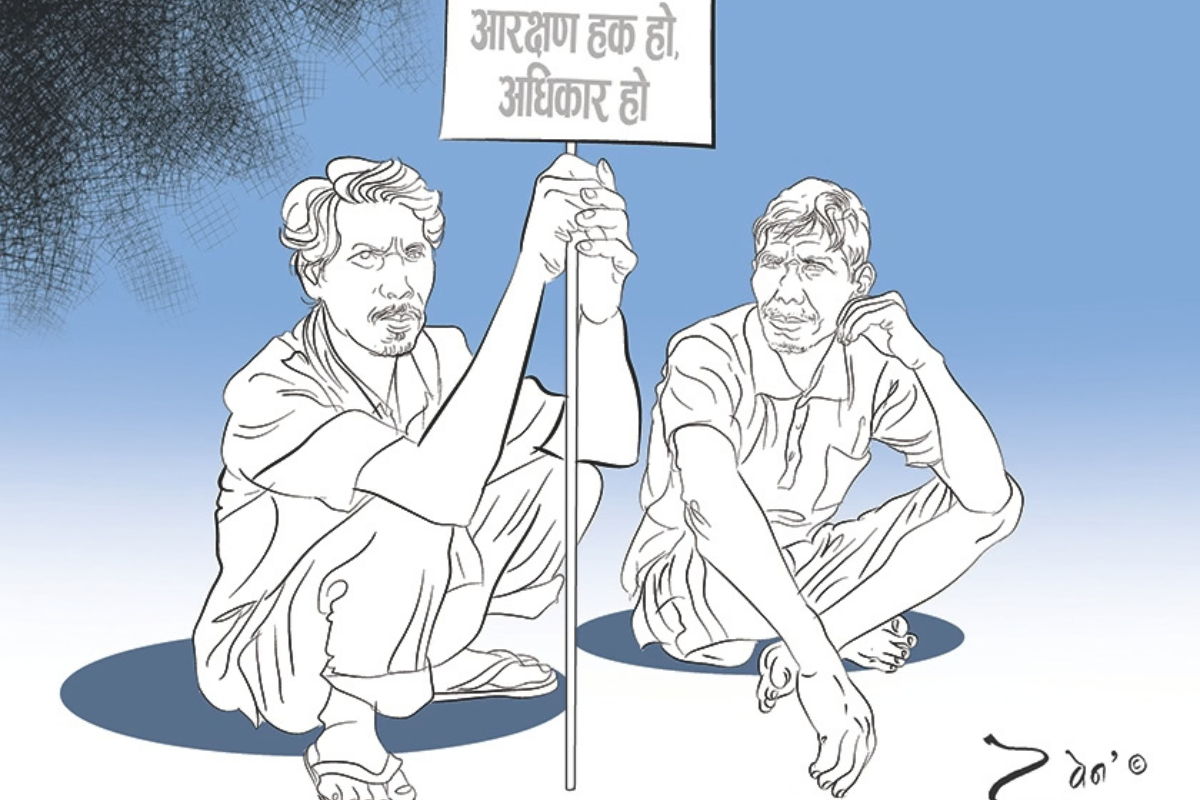





Nepal’s debate over reservation has once again come to the forefront. A few days ago, Rupa Sunar, a young woman from the Dalit community, was reportedly refused a room for rent by a landlord in Babarmahal, Kathmandu, because she is Dalit. She is currently in police custody for investigation. Meanwhile, discussions on social media and even in everyday public spaces have increasingly taken a direction suggesting that the Dalit community is now facing discrimination because it receives reservation benefits.
The older generation, which remained outside the mainstream of education and was influenced for generations by caste-based social thinking, was generally unsympathetic toward the Dalit community. Such incidents still occur sporadically.
However, when a section of educated young people, including university graduates, begins openly criticizing the system, it is worth questioning both their mindset and aspects of the education system itself. Is the Dalit community the only group in Nepal receiving reservation benefits? What about women, Madhesis, indigenous nationalities, people from backward regions, persons with disabilities and orphans? Have they not received reservation opportunities?
When Dalits continue to face caste-based discrimination even in the 21st century, turning the issue of reservation into a superficial debate is deeply problematic.
A community that has faced institutionalized discrimination by the state for generations may understandably view reservation as a form of affirmative action. Yet opposition to such measures among young Nepalis, intellectual circles and those inclined toward ethnic polarization could contribute to social confrontation. A ball bounces higher the harder it is pressed down. It is important to recognize that discrimination and inequality have historically contributed to conflict and social upheaval.
Let us therefore examine the issue of reservation more closely.
Many scholars around the world have written about affirmative action, or reservation.
Political theorist Iris Marion Young and other analysts and experts have described affirmative action as a group-focused social policy designed to address the conditions of oppression faced by particular communities. It is one mechanism for promoting equality by addressing historical injustice against marginalized groups.
Clarifying this further, Crosby describes it as a policy intended to correct past injustices and help reduce inequality. Goldman, meanwhile, explains the policy through both backward-looking and forward-looking principles.
The backward-looking dimension seeks to address past injustices through affirmative policies or reservation, while the forward-looking dimension aims to help establish greater equality in the future.
Affirmative action or reservation is therefore not simply a policy designed to provide identical opportunities to every group. Rather, it is an important strategy for empowering communities that have historically and currently experienced exclusion and bringing them into the mainstream of the state.
These arguments suggest that communities occupying historically privileged positions in the caste structure, and those that have not experienced discrimination based on caste, language or region, should carefully consider the purpose and rationale of reservation.
Nepal’s Constitution provides for reservation and proportional inclusion of women, Dalits, indigenous nationalities, Khas-Arya, Madhesis, Tharus, Muslims and people from backward regions in political and administrative spheres. As a result, Nepal has witnessed sustained debate over reservation in recent years.
The constitutional framework is based on the understanding that affirmative-action programmes may be necessary for a certain period until specific goals of inclusion are achieved.
Young and socially conscious people expressing their views on social media have been openly debating both the merits and criticisms of reservation. Although capacity development and competition are important for participation in the organs of governance, the concept that equal competition is not always possible among citizens and communities with unequal starting conditions has increasingly gained recognition. As a result, affirmative action and reservation have been practiced as specific strategies for promoting inclusion.
A society may contain people from different castes, ethnicities, languages, cultures, genders and regions. When participation in a particular public service is dominated by only a limited group or region, the service may be criticized for lacking representation and for failing to adequately respond to the needs of the wider population.
To increase the participation of historically marginalized communities in the civil service, affirmative action and reservation provisions were introduced in Nepal’s Civil Service Act, 2049, initially with a ten-year framework.
As societies become more educated and socially conscious, and as states become more accountable to their citizens, affirmative-action policies have been viewed as a means of addressing the historical consequences of inhuman practices that treated people unequally or discriminated against them simply because of their caste, community, race, gender or place of birth.
Even countries now regarded as developed once adopted inclusive provisions in areas such as government employment, although many of those measures are no longer maintained in the same form. Continuing reservation indefinitely may create distortions, potentially denying opportunities to highly qualified individuals while relying on less-qualified candidates. However, reservation remains necessary until those who were historically disadvantaged and systematically denied opportunities can reach a position of genuine equality and compete on a more level playing field. Nepal’s Constitution of 2015 recognizes this need.
Nepal has also experienced situations in which members of the same family repeatedly benefit from opportunities reserved for Dalits. Similarly, there have been instances where women from political, administrative and elite backgrounds repeatedly benefited from opportunities reserved for women.
Therefore, reservation can be compared to the first gear needed to get a vehicle moving. But if the vehicle remains permanently in first gear, it cannot enter a competitive race.
Candidates entering through reservation quotas must still meet the minimum requirements of the Public Service Commission’s selection process. The difference is that candidates competing under a reservation category compete among members of the relevant group, while those who fail to meet the minimum eligibility requirements cannot enter the service.
There is also no sufficient research-based evidence to establish the claim that employees who entered through reservation quotas are inherently incapable. Since reservation has been implemented for only a relatively short period, it is also too early to make a definitive assessment of their overall performance and capability.
This opinion by Shiva Regmi was published in News of Nepal on 9 Asar 2078 (June 23, 2021).
 Arguments For and Against Reservation
  The Meaning of Reservation
  Creative Initiative by Nepali Peacekeepers in South Sudan