


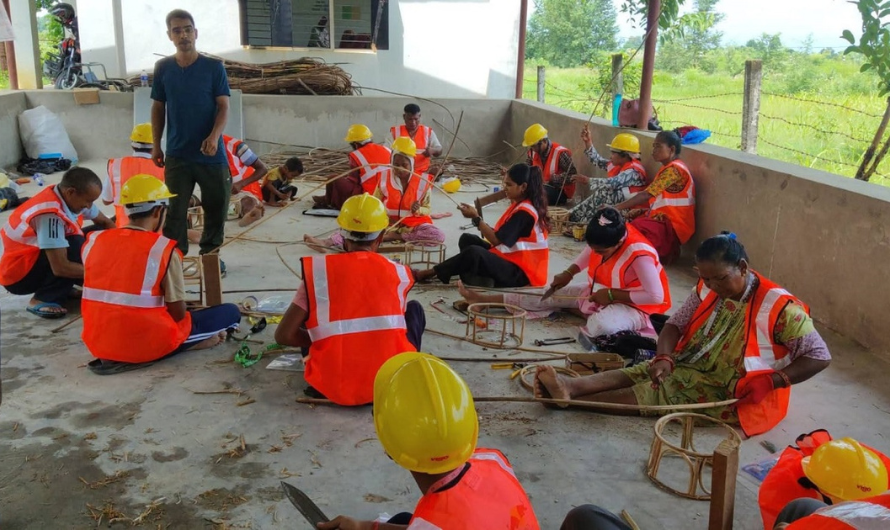
Bardiya : From morning until evening, Sita Chaudhary’s daily routine revolves around household chores, caring for her husband and meeting the family’s everyday needs. This has been her reality for nearly two decades. After her husband, Bir Bahadur Chaudhary, became severely disabled following an accident, much of Sita’s time has been devoted to his care.
The accident not only changed her husband’s life but also weakened the family’s financial foundation. For Sita, taking up regular employment or working outside the home became increasingly difficult. Since she could not leave her husband unattended for long periods, opportunities to earn an income gradually became limited.
Sita’s story, however, is not an isolated one.
Deviram Tharu, from the same area, has also spent years caring for his mother. After his mother became severely disabled due to health problems, including high blood pressure, Deviram was unable to pursue employment outside the home. Caring for his mother became his priority, but it also left him with limited opportunities to earn a living.
A New Opportunity to Earn from Home
For Sita and Deviram, who have been living under similar circumstances, a new possibility has emerged. Unable to leave home for long periods, they have now received an opportunity to learn skills that can be practiced from home.
The Bardiya Disability Rehabilitation Center has started providing training in making bamboo and cane products to persons with disabilities and their family members. The training has brought a new sense of hope to their daily lives. During the nearly month-long training, participants are learning to make products such as stools, prayer baskets and hangers.
For Sita, the training is more than just an opportunity to learn a new skill. It is a chance to explore a source of income within the limitations of her circumstances. She believes she can use her free time productively while continuing to care for her husband.
“I now have hope that I can earn some income while staying at home after learning these skills,” Sita says.
For Deviram, too, the skills have opened up the possibility of resuming some form of economic activity after years of being confined to caregiving responsibilities.
“I could not go outside to work because I had to care for my mother,” he says. “Now I have learned how to make different products while staying at home.”
Skills and Hope for Self-Reliance for 20 Families
Sita and Deviram are only two examples. Twenty persons with disabilities and their family members from Gulariya, Bansgadhi and Barbardiya municipalities and Badhaiyatal Rural Municipality are benefiting from the training.
Following the training, participants have started making various bamboo and cane products. Since the work can be done at home during available free time, it is expected to provide an opportunity to combine caregiving responsibilities with income generation.
The program is being implemented by the Bardiya Disability Rehabilitation Center with financial support from RRN, DGM Nepal and Abilis Foundation. According to the center, the objective is not simply to provide training but to connect the skills with production, income generation and access to markets.
‘Disability Should Not Be Seen as an Economic Burden’
According to the center, around 17,000 persons with disabilities live in Bardiya. Of them, approximately 5,000 people with severe disabilities are living with direct support from their families.
In such households, caregiving responsibilities often affect the employment and income-generating opportunities of other family members, says Netra Sapkota, chairperson of the Bardiya Disability Rehabilitation Center.
He says it is important to change the perception of persons with disabilities as merely an economic burden on their families. With appropriate skills, opportunities and support, they can engage in productive activities according to their abilities, he says.
“Persons with disabilities can also become self-reliant when they have the right skills and opportunities,” Sapkota says. “That is why we organized this training on making bamboo and cane products.”
The Challenge of Finding a Market
Learning to make products is only one part of the process; finding a market for those products is another challenge. The organization has said it will support the marketing of products if participants are unable to sell them on their own.
The center says bamboo and cane products have good market demand and that it is working to connect local production with the market. It is also taking steps to source the bamboo and cane required as raw materials from local community forests.
The initiative is expected to provide benefits on two fronts—making use of local resources while creating opportunities for home-based employment. Since bamboo and cane products are environmentally friendly, the center believes their production can bring both economic and environmental benefits.
An Effort to Become Self-Reliant While Providing Care
For family members who provide regular care to people with severe disabilities, pursuing employment outside the home is not always possible. The costs of medication, caregiving and daily necessities can further increase the financial pressure on such households.
For Sita and Deviram, therefore, learning bamboo and cane craft is more than an ordinary training program. It has become a way to explore opportunities for earning an income without having to leave home.
Their caregiving responsibilities are not going away anytime soon. But within those responsibilities, a new possibility has emerged—to turn time and skills into productive work, generate income and contribute to easing the financial burden on their families.
The skills may not transform their lives overnight. But they could mark the beginning of turning the time and labor long confined within the four walls of their homes into an opportunity for production and self-reliance.
 Naresh Admits Using a Saw to Dismember and Dispose of Wife Mamata’s Body
 China and Bangladesh Pledge to Stand Together Despite Global Changes
 Foreign Minister Khanal Holds Talks with Indian Foreign Secretary Misri
 Indian Foreign Secretary Arrives in Kathmandu
 Russian Bombing of School Serving as Aid Centre Kills 33 in Ukraine